This course provides the necessary grounding in algebra, calculus, vectors, and complex numbers to students pursuing engineering degrees. Most of the content would be a review or extension of mathematics topics encountered since high school and pre-university. The intention is to ensure that students acquire a common core of mathematical competencies essential for subsequent technical courses.
This subject introduces the fundamentals of digital systems, covering Boolean algebra, logic gates, and circuit simplification. Students will learn to design and analyze combinational and sequential circuits such as adders and counters
This course introduce laws of circuit theory and the behaviour of circuits during steady-state and transient conditions.
Course Summary:
This module aims to provide students the opportunity to learn and use various types instruments used for engineering measurements. The gained knowledge will be based upon the principles and concepts of electrical measurement theory and practice. The main objective is to provide an understanding of measurement capabilities and limitations. Topics covered will include analogue and digital instrumentation, signal conditioning, sensors and transducers.
Lecturer Name: Assistant Prof Ir. Dr. Lian Wen Xun
Timeline: 06/04/2026 - 10/07/2026
This course introduces the fundamental concepts and operating principles of electrical machines, as well as the basics of electrical power systems and their protection.
This course provides a thorough introduction to the C programming language, covering the fundamental topics in C programming language and the basics of Unix System Interface.
This course provides fundamental knowledge of the principles, concepts and application of mechanics for solving engineering problems. Topics to be covered include equivalent systems of forces, resultants and distributed forces, equilibrium of rigid bodies, centroids, centers of gravity, fluid statics, moments of inertia, and friction.
This course provides basic knowledge about machine learning problems and methods. Concepts include decision trees, neural networks, Bayesian Learning, Instance-Based Learning, Reinforcement Learning, and distributed learning. All the techniques are practiced within some existing tools, such as sklearn and Tensorflow. The students will work on a group project, presenting their application with the knowledge and skills from this course.
Lecturer: Tony Hii Chang Soon
This course provides a thorough introduction to the Python programming language. It will cover the basic syntax and grammar and expose students to practical programming techniques. Besides, this course offers the students about programming and application of NumPy and Tensorflow, which are the necessary tools for intelligence systems. More importantly, the students should be prepared to work in Linux environment.
Lecturer: Tony Hii Chang Soon
This course provides the basic knowledge of artificial intelligence and related mathematics. To be general and detailed, the topics include searching, heurisitc searching, simulated annealing, gradient method, computational intelligence, decision trees, naive bayes, k nearest neighorhood, linear models, support vector machine, deep learning components. Given the students are without math foundation, we provide the prerequities in the first class, while in the final class, the students shall finish one project and present this project in class.
Lecturer: Tony Hii Chang Soon
The course develops advanced calculus concepts, covering partial differentiation, multiple integrals, vector calculus, and Fourier series. The course focuses on multivariable analysis, spatial modelling, and signal representation, providing mathematical foundations for robotics, control, and engineering system analysis.
This course follows up on ERA115 Engineering Mathematics 1 to introduce students to differential equations. Many physical laws are expressed mathematically as differential equations, and scientists/engineers must know how to solve those equations and interpret the solutions. This course focuses on ordinary differential equations, and the requisite concepts and analysis tools to understand and solve them, including integral transforms. The course also emphasizes on developing strong skills in essential concepts in probability and statistics.
To study various types of transistor amplifiers, analysis concepts and their applications.
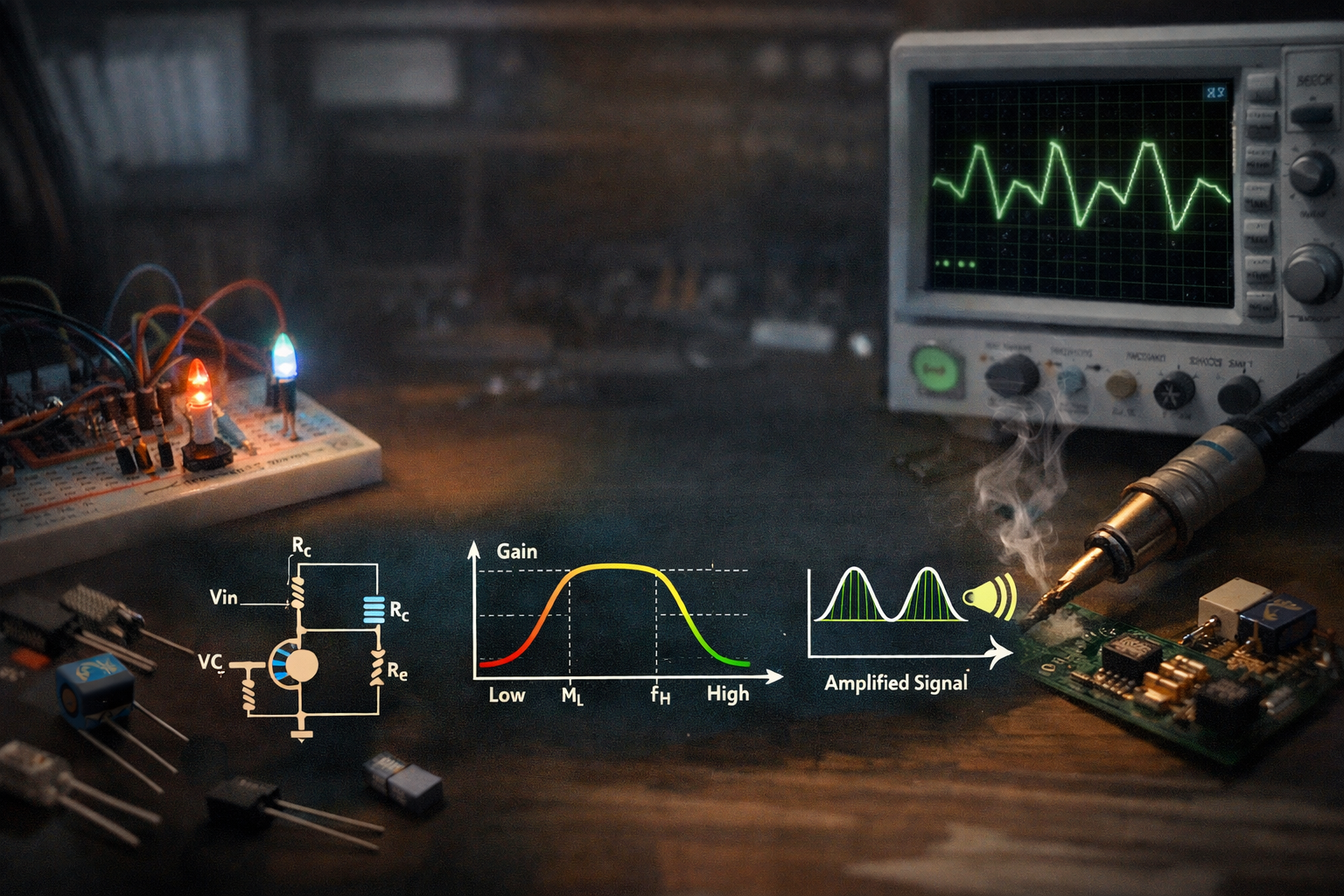
This course introduces fundamental electronic components essential for robotics applications, including diodes, transistors, and their practical uses in circuits. Students will develop a solid understanding of these devices, their operating principles, and their role in robotic systems, sensors, and control circuits.

This course provides a foundation for students to understand modern computer system architecture with a focus on its applications in robotics. It equips students with essential knowledge, fundamental concepts, and design techniques relevant to robotics computing, including performance trade-offs, hardware-software interactions, and real-time processing. Key topics include machine structures, embedded system architectures, parallel processing, and multicore computing, all within the context of robotic systems. The course is structured around the three primary components of computing in robotics: processors for control and computation, memory systems for efficient data handling, and networks for communication between robotic subsystems.

This course is about logic gates,combinational logic circuits,sequential circuits and the application of these circuits in digital system.
This course introduce laws of circuit theory and the behaviour of circuits during steady-state and transient conditions.
This course includes the study of systems of linear equations, matrices, determinants, vectors, vector spaces, linear transformations, inner products, eigenvalues, eigenvectors, symmetric matrices and quadratic forms.
This subject introduces the fundamentals of digital systems, covering Boolean algebra, logic gates, and circuit simplification. Students will learn to design and analyze combinational and sequential circuits such as adders, counters and finite state machines.
This course provides a thorough introduction to the Python programming language. It will cover the basic syntax and grammar and expose students to practical programming techniques. Besides, this course offers the students about programming and application of NumPy and Tensorflow, which are the necessary tools for intelligence systems. More importantly, the students should be prepared to work in Linux environment.
Lecturer: Tony Hii Chang Soon
This course provides the basic knowledge of artificial intelligence and related mathematics. To be general and detailed, the topics include searching, heurisitc searching, simulated annealing, gradient method, computational intelligence, decision trees, naive bayes, k nearest neighorhood, linear models, support vector machine, deep learning components. Given the students are without math foundation, we provide the prerequities in the first class, while in the final class, the students shall finish one project and present this project in class.
Lecturer: Tony Hii Chang Soon
This core course for the ERA programme introduces the fundamental concepts and operating principles of electrical machines, as well as the basics of electrical power systems and their protection.
This core course for the ERA programme provides a thorough introduction to the C programming language, covering the fundamental topics in C programming language and the basics of Unix System Interface.
This course introduces fundamental electronic components essential for robotics applications, including diodes, transistors, and their practical uses in circuits. Students will develop a solid understanding of these devices, their operating principles, and their role in robotic systems, sensors, and control circuits.
To study various types of transistor amplifiers, analysis concepts and their applications.
This course provides a foundation for students to understand modern computer system architecture with a focus on its applications in robotics. It equips students with essential knowledge, fundamental concepts, and design techniques relevant to robotics computing, including performance trade-offs, hardware-software interactions, and real-time processing. Key topics include machine structures, embedded system architectures, parallel processing, and multicore computing, all within the context of robotic systems. The course is structured around the three primary components of computing in robotics: processors for control and computation, memory systems for efficient data handling, and networks for communication between robotic subsystems.